Finance Data Architecture
We design and build the data architecture that underpins your entire finance function — clean, integrated, and structured to support reporting, planning, and advanced analytics at the scale your business operates today and needs to reach tomorrow.
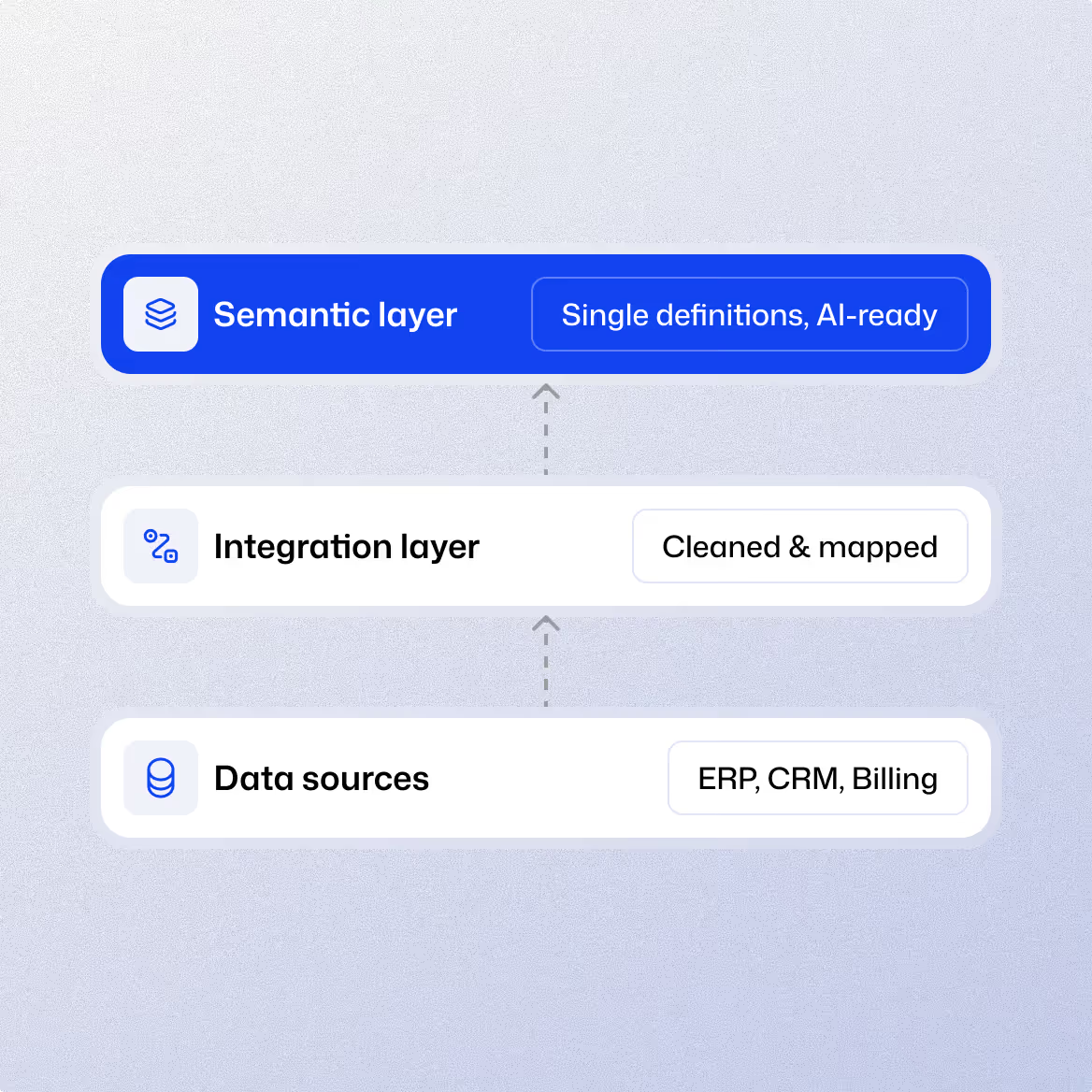
Most finance data problems are architecture problems. The data exists. It just lives in the wrong structure — and getting it out requires manual work every single cycle.
Data scattered across disconnected systems
ERP transactions, CRM data, operational metrics, and planning figures sit in separate systems with no consistent integration layer. Every report that crosses system boundaries requires manual assembly — which means every report carries reconciliation risk and costs finance team time that should go to analysis.
Technology investments that underdelivered
BI tools, data warehouses, or reporting platforms were implemented — but didn't deliver the expected value. The technology was sound. The data architecture underneath it wasn't. Without a solid foundation, the tools can only partially function — and the investment sits underperforming.
No single definition of financial truth
Revenue is calculated differently in the ERP, the CRM, and the management report. Cost centres don't map consistently across systems. When the numbers depend on who produced them, the architecture is the problem — and no amount of reporting redesign fixes an architecture problem.
Reporting infrastructure that can't scale
Current reporting works for the current volume, the current number of entities, and the current analytical requirements. Add a business unit, a new market, a demanding investor, or a group consolidation requirement — and the architecture breaks down.
What changes when we're done
From data landscape to designed and built architecture.
Data Landscape Assessment
We map every data source, integration point, and reporting output in your current environment. Data quality assessed at source. Gaps, inconsistencies, and architectural constraints identified before design begins.
Architecture Design
Data model, integration architecture, and semantic layer designed. Every design decision documented and validated with your finance and technology leadership before build begins.
Build & Implementation
Data model built, integrations implemented, semantic layer deployed. Data quality framework established. Finance and technical teams trained. Reporting outputs validated against new architecture before old infrastructure is retired.
This service fits if
Your data lives in too many places
Multiple ERPs, local systems, and operational platforms across entities and geographies — with no consistent integration layer. Every cross-system report is a manual exercise that introduces reconciliation risk.
Technology investments haven't delivered
BI tools or reporting platforms were implemented but produce inconsistent or unreliable outputs. The root cause is the data architecture — not the technology sitting on top of it. Fixing the tools without fixing the foundation produces the same result.
You're scaling reporting or analytical requirements
A more demanding board, an incoming investor, or a group consolidation requirement has exposed the limits of your current data architecture. It worked at a smaller scale. It won't work at the next one.
AI or advanced analytics is on the roadmap
Any meaningful use of AI or advanced analytics in finance requires a clean, well-structured data foundation. Without it, AI deployment produces unreliable outputs — and creates more problems than it solves.
Finance data architecture is the foundation everything else is built on. BI tools, AI agents, group consolidation models, and automated reporting all depend on it. Built correctly, it delivers returns across everything built on top of it.

Every reporting and analytics investment you make depends on the data architecture underneath it.
30 minutes. We'll assess your current data landscape and tell you what a properly designed architecture would change — for reporting, for planning, and for every technology investment that follows.
What CFOs ask before they engage
We already have a data warehouse. Does this replace it?
Not necessarily. We assess your existing data infrastructure as part of the landscape review and design around it where it's sound. In many cases the data warehouse is adequate — the issue is the data model and semantic layer built on top of it, or the quality of data flowing into it. We fix what needs fixing rather than replacing what's working.
How do you handle SAP or NetSuite as the source system?
We have deep experience designing integration and data model architecture around SAP and NetSuite as group-level systems — accounting for their specific data structures, API capabilities, and the subsidiary system landscape that typically surrounds them.
Do we need a dedicated data engineering team to maintain this?
Not necessarily. We design for the internal capability your team actually has — or will have. The architecture documentation, data quality framework, and governance model are built to be maintainable without specialist data engineering resource in most cases.
How does this connect to BI, reporting, and AI development?
Finance data architecture is the prerequisite for all of it. We sequence architecture design and build before reporting development, BI implementation, and AI deployment — so every subsequent investment is built on a foundation that's clean, consistent, and scalable.