Finance Data Architecture: The Foundation Your BI and AI Investments Depend On

Most companies discover they have a finance data architecture problem after they have already bought the tool that was supposed to solve it. The problem is not the tool — it is what the tool is sitting on. Fixing the architecture before the next implementation is not a technical decision; it is a strategic one with direct consequences for close speed, board credibility, and whether your AI investment ever returns a number anyone will sign off on.
The pattern that costs CFOs two years
When a finance function cannot produce reliable, timely consolidated numbers, the instinct is to buy something. A new FP&A tool. A BI platform. Sometimes an AI layer that promises to surface insights from existing data. These investments fail — not because the tools are bad, but because the data underneath them is structurally broken.
Gartner research puts the average annual cost of poor data quality at $12.9 million per organisation. In finance, that figure understates the damage: a broken data foundation means every report, every board pack, and every decision downstream inherits the error. The tool becomes a more expensive version of the same broken process.
The problem has a name: no coherent finance data architecture.
What finance data architecture actually is
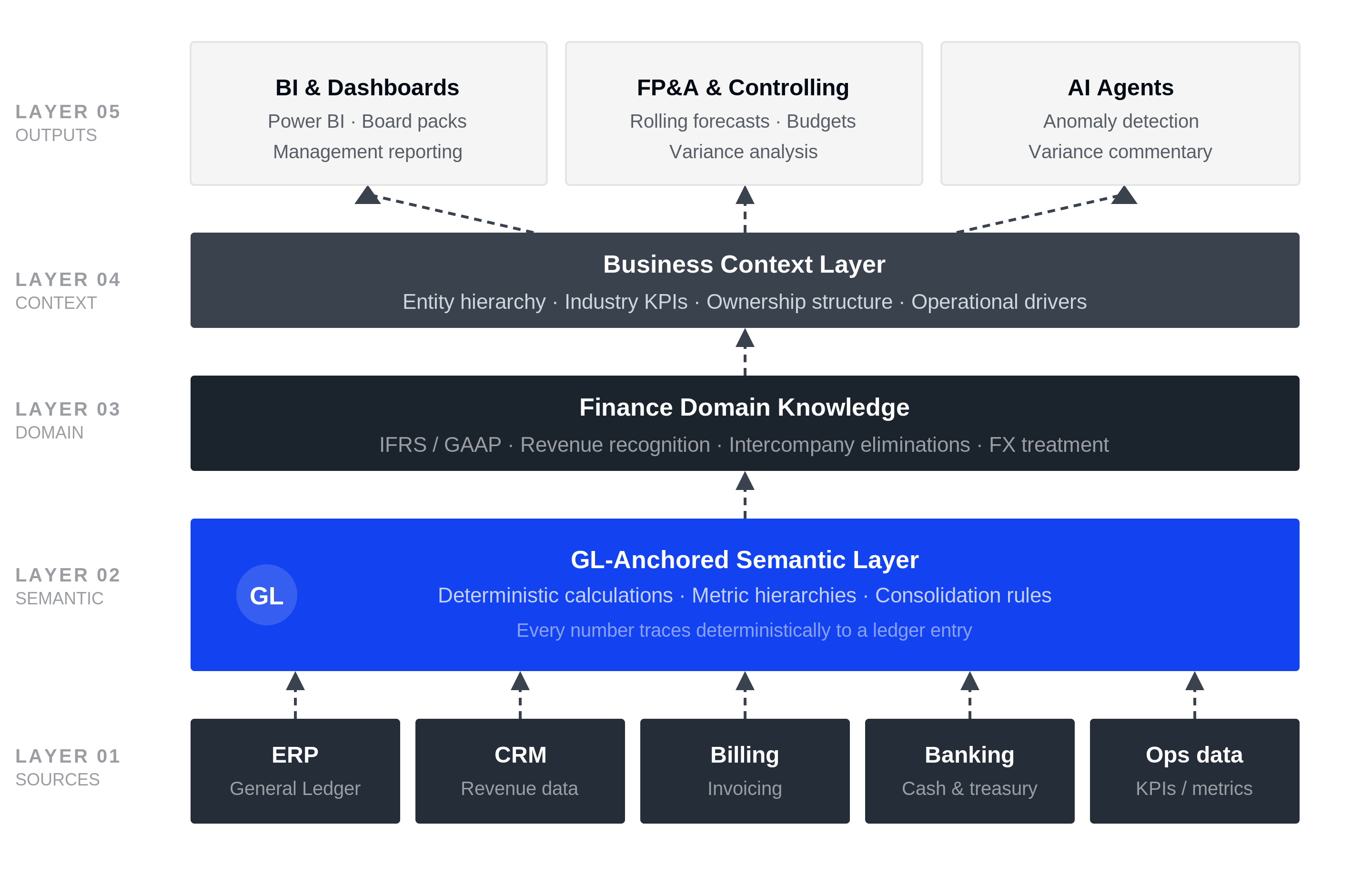
Finance data architecture is the structural design that determines how financial data flows from source systems into a single, reliable, auditable picture of the business. It has five components.
The GL as spine. Every source system — ERP, CRM, billing platform, banking feeds, operational data — must reconcile to the general ledger. Not approximate it. Not run in parallel. Reconcile to it. The GL is the only structural point of truth in any finance function. Architecture that is not anchored to the GL is analytics guesswork dressed up as reporting.
The semantic layer. Above the GL sits a defined set of calculations, hierarchies, and relationships that translate raw ledger data into business concepts: revenue by segment, gross margin by entity, EBITDA by business unit. These definitions must be computed deterministically — the same calculation, from the same source, every time. This is what makes a number trustworthy enough to present to a board.
Consolidation-grade data. The output of a well-designed finance data architecture is data that consolidates across entities, currencies, and ERPs without manual heroics. It is the prerequisite for everything that follows: management reporting, board packs, FP&A models, and AI.
The finance domain knowledge layer. A semantic layer computes numbers correctly, but does not make them financially meaningful on its own. The domain knowledge layer encodes the rules that govern how numbers are interpreted in finance: accounting standards (IFRS, local GAAP), revenue recognition policies, intercompany elimination logic, FX treatment across currency pairs, EBITDA adjustment definitions. Without this layer, the architecture produces data - not finance. Building it requires data architecture skills and finance expertise working in the same room. This is where a finance data architecture engagement diverges from standard data engineering — and where the risk of getting it wrong is highest.
The business context layer. Every business has a different shape, and the finance function must reflect that shape rather than work around it. The business context layer encodes what is specific to this company: how the entity hierarchy maps to reporting lines, which cost centres belong to which P&L, what revenue means in this industry and ownership structure, which operational drivers are the leading indicators for financial outcomes. Without this layer, finance outputs are structurally sound but not calibrated to the decisions the business actually needs to make. incro builds both the domain knowledge and business context layers as part of every finance data architecture engagement — it is what makes the outputs relevant, not just correct.
Why GL-anchored is more precise than single source of truth
Single source of truth is a phrase most finance teams have heard and most have stopped believing. It has become synonymous with the thing the company wanted and never achieved. A more useful term is GL-anchored semantic layer: a semantic layer in which every metric traces deterministically back to a ledger entry — not to a spreadsheet, not to a dashboard calculation, but to the ledger.
When a CFO asks where does this number come from, a GL-anchored semantic layer can answer. Most existing setups cannot.
Three failure modes a broken architecture produces
Hero-dependent consolidation. The group closes its books because one person in the finance team holds the consolidation together manually. GLs do not truly map across entities. CRM and billing data have different shapes in every country. Month-end is an act of heroism, not a process. When that person leaves, the consolidation breaks. This is the most common — and highest-risk — presentation of a broken finance data architecture.
Tool inheritance. A new BI platform or FP&A tool is deployed on top of an unaddressed data foundation. The dashboards look good. The numbers are wrong. The team spends more time arguing about figures than acting on them. The tool gets blamed. The architecture problem persists and will surface again with the next tool.
AI hallucination. An AI layer is added to provide insights and commentary. Because the semantic layer underneath is not deterministic and not GL-anchored, the AI produces results that look plausible but cannot be traced. The CFO cannot sign off on them. Trust in AI for finance collapses before it was ever properly tested.
All three failure modes have the same root cause and the same fix.
What consolidation-grade data looks like in practice
A PE-backed business services group, €180M revenue, 11 entities across four countries, ran a close that took eighteen working days. Finance had three ERPs, billing data in two separate systems, and a consolidation that lived in one controller's spreadsheet model. When that controller went on leave, close stretched to twenty-four days. The board pack contained numbers that differed between the CFO deck and the management accounts by €300K — a reconciling item nobody could trace without four hours of manual work.
After rebuilding the data architecture — a unified chart of accounts, a GL-anchored semantic layer connecting all three ERPs and the billing systems, automated consolidation pipelines — close ran in seven days. The €300K discrepancy disappeared. Board pack preparation dropped from five days to one. The architecture work took twelve weeks. The close acceleration paid for it inside the first quarter.
When to address this
Finance data architecture problems do not announce themselves cleanly. They surface as symptoms: slow closes, unreliable consolidations, board packs that require re-explanation, BI tools the finance team does not trust. The triggers that create the best conditions for fixing them are narrow.
ERP migration or replacement. The strongest moment to act. Done with architecture in mind, it establishes a clean chart of accounts, defined semantic layer, and integrated source connections from day one. Done without it, an ERP migration embeds the same structural problems in newer, more expensive software.
New CFO or Head of FP&A. Someone without inherited loyalty to the existing setup is willing to challenge it. The window is typically three to six months before operational demands absorb the appetite for structural change.
Post-acquisition. Entities that need to be brought into a group consolidation expose every structural weakness in the existing architecture. The moment is urgent and the business case is unambiguous.
BI rebuild or FP&A tool replacement. When a BI platform or FP&A tool is being replaced, the chance to fix the foundation this time has the highest probability of being actioned — and the highest cost if ignored again.
None of these windows last long. The business moves on to the next priority in months, not years.
The order of work is non-negotiable
The companies that have deployed AI agents for anomaly detection, variance commentary, and treasury monitoring — and whose CFOs trust the outputs — did not start with the AI. They started with the foundation.
Finance data architecture is Layer 01 of any credible finance transformation. Management reporting and BI sit on top of it. AI agents sit above that. Skipping the foundation is why most AI in finance projects produce impressive demos and untrustworthy production results.
We compute the number deterministically. We let AI explain it.
This is not a philosophical preference — it is an audit requirement. A board-level number must trace to a source. If it cannot, it does not belong in the board pack, regardless of how sophisticated the tool that produced it.
The finance data integration work — connecting ERPs, billing systems, banking feeds, and CRM to a single GL-anchored semantic layer — is not glamorous. It involves rebuilding chart of accounts, mapping entity hierarchies, defining calculation rules, and building integration pipelines. It is also, without exception, the work that makes everything downstream trustworthy.
Is the architecture the problem?
If your consolidation depends on one person, your BI dashboards produce numbers your team debates rather than acts on, or your last AI investment never made it past the demo — the data foundation is where to start. Talk to us about what clean finance data architecture looks like for your group, and whether the business case for addressing it now is there.
Matt co-founded incro in 2020. Since then, he has worked with over 100 companies - from early-stage startups to PE-backed businesses across a wide range of industries.
He is an expert in corporate finance, FP&A set-up, and forecasting, and has built a reputation for turning complex financial functions into clear, board&investor-ready systems.
At incro, Matt drives company growth while designing the analytical frameworks and solutions that define how the firm delivers transformation — including co-creating CFO Studio, incro's AI-powered financial analysis platform.
He holds a degree from SGH Warsaw School of Economics and is the author of Methods and Procedures in the Assessment of Capital Investments (Difin, 2023), a rigorous framework for evaluating investment profitability, now used as an academic reference. Matt was named to the Forbes 30 Under 30 Poland list in 2025.
Your financial data won't fix itself.
30 minutes. We'll tell you exactly where your data is costing you money — and what AI can do about it.

