Finance Data Integration
We design and build the data integration infrastructure that connects your finance systems — ERP, CRM, operational platforms, and subsidiary systems — into a unified, automated data environment your finance function can depend on every cycle.
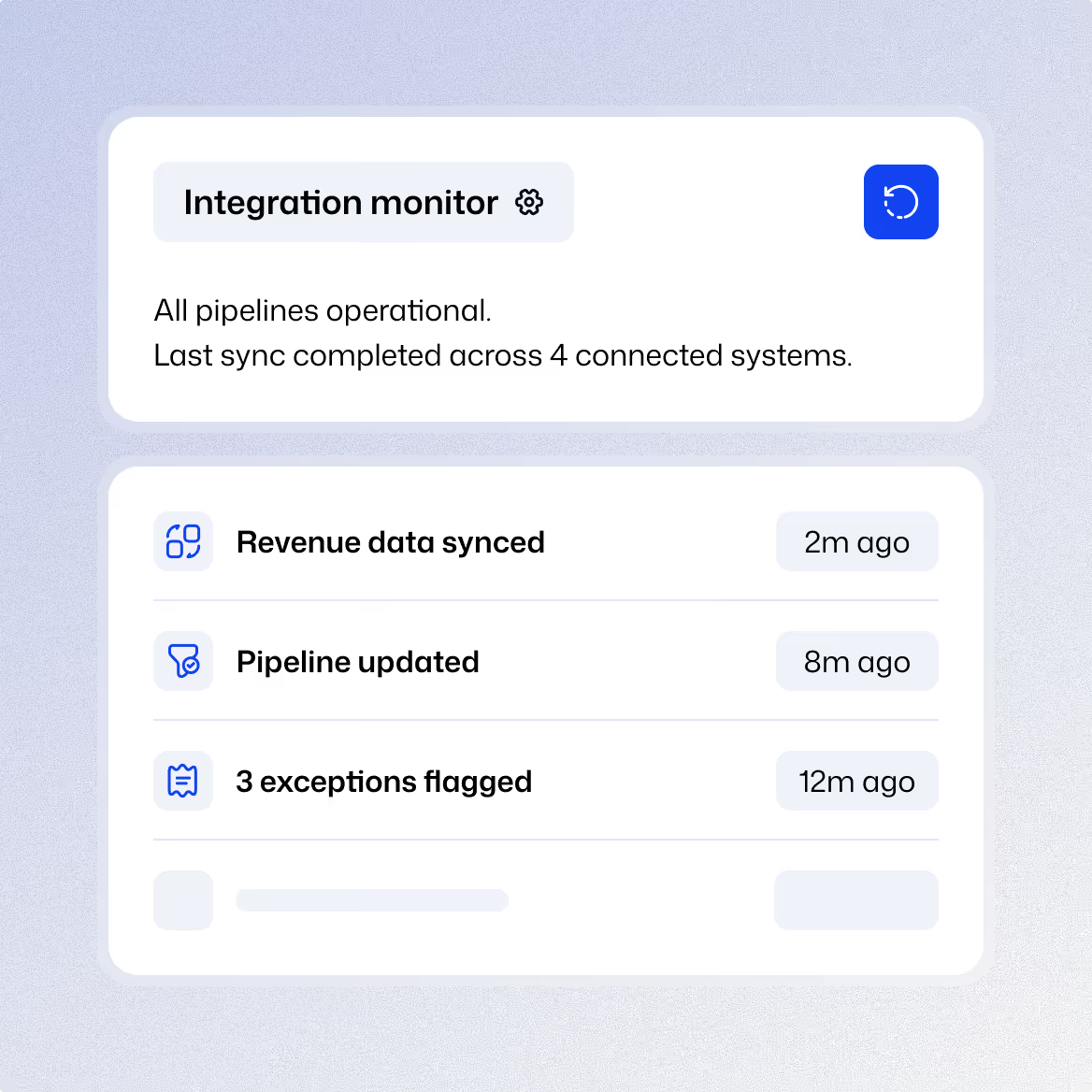
Manual data movement between systems is the source of more finance errors — and more reporting delays — than most organizations ever formally measure.
Data extracted manually from every source system
Every reporting cycle begins with exports from SAP, NetSuite, or local ERPs — transformed manually and loaded into reporting tools or consolidation models. Each manual step is a reconciliation risk and a time cost that compounds every month. It's also where most reporting errors originate.
No single authoritative version of financial data
Because data is moved manually between systems, the same financial figure exists in multiple versions — each potentially processed differently. The question "which number is right?" has no clean answer when there's no integration layer producing a definitive one.
Subsidiary systems disconnected from group infrastructure
Local entities run their own ERP or accounting systems — with different chart of accounts, different currencies, different closing timelines. Integrating their data into group reporting is a manual exercise repeated every period — and its reliability depends entirely on the same people executing the same steps correctly every time.
Integration projects that were never completed
System migrations, ERP implementations, and acquisition integrations produced integration plans that were partially executed. Legacy manual workarounds fill the gaps — and they've been there long enough to be treated as normal. They're not normal. They're risk.
What changes when we're done
From disconnected systems to integrated data infrastructure.
Integration Landscape Assessment
Every source system, data flow, and manual integration process mapped. Data quality assessed at source. Integration architecture designed around your specific system landscape and reporting requirements.
Integration Build
Pipelines built and tested iteratively — highest priority integrations first. Transformation logic validated against real data. Finance and technology teams involved in sign-off at each stage.
Deployment & Stabilization
Integrations deployed to production. First full reporting cycle on automated pipelines completed. Monitoring and alerting active. Manual processes retired as automated replacements are validated.
This service fits if
Every reporting cycle starts with manual data extraction
Exports from source systems, manual transformations, and file-based loading are the foundation of your reporting process. The cycle is as long as it is — and as error-prone as it is — partly because it always starts with this work.
Subsidiary systems aren't connected to group infrastructure
Acquired entities or new market operations run systems that aren't integrated with group. Their data arrives manually — with the reconciliation risk, timing dependency, and quality uncertainty that creates.
An ERP implementation or migration is planned
A system change is the right moment to design integration architecture properly — rather than recreating manual workarounds in a new environment and inheriting the same problems.
Data quality issues trace back to the integration layer
Inconsistencies in reporting outputs trace back to data that was transformed or loaded incorrectly during manual integration. The fix is in the architecture, not in the data itself.
Data integration infrastructure is what makes everything else in finance technology reliable. Every reporting tool, consolidation model, and AI agent built on manual data flows inherits the risk and the delay of those flows.
Automated data infrastructure isn't a luxury. It's the baseline for a finance function that scales.
30 minutes. We'll map your current integration landscape and tell you what a properly built integration architecture would change for your reporting cycle and data reliability.
What CFOs ask before they engage
Which systems do you integrate with?
We build integrations across the major enterprise finance systems — SAP, NetSuite, Microsoft Dynamics, and others at group level — as well as the range of local ERP and accounting systems that typically exist in subsidiary landscapes. We also integrate with CRM platforms, operational systems, and third-party data sources where finance reporting requirements demand it.
How do you handle different chart of accounts across entities?
Chart of accounts mapping is a core component of every integration design. We build the transformation logic that maps local account structures to group definitions — so subsidiary data arrives at group level already aligned, rather than requiring manual rework at consolidation.
What happens when source systems are updated or changed?
Integration maintenance is designed into the governance framework from the outset. When source systems change — new fields, schema updates, ERP version upgrades — the maintenance process is defined, owned, and executed without disrupting downstream reporting.
How does this relate to our data architecture?
Data integration infrastructure is the layer that feeds the data architecture — delivering data from source systems in the right structure, on the right schedule, with the right quality. We sequence integration design after data architecture design to ensure what's built serves the architecture it feeds.