Microsoft Fabric vs CFO Studio: Which One for AI in Finance?

Microsoft Fabric and CFO Studio are not competitors on the same shelf. Fabric is a data platform with a context layer for AI agents, and now with its own planning tool. CFO Studio is a ready-made finance application for teams of 5 to 50 people, with the logic Fabric does not provide. It goes live in weeks, and it can run on top of Fabric.
Since FabCon Europe in Barcelona (29 September 2026), CFOs ask us this more and more. IT says: “we’re on Microsoft, let’s do it on Fabric and Copilot”. Sometimes that’s the right call. Sometimes it means a year of building what could be live in a few weeks.
We deliver on Power BI and Fabric, and we build CFO Studio. This article isn’t meant to win a comparison. It’s meant to help you pick the right tool.
What Microsoft Fabric is in October 2026
Fabric is no longer “Power BI with a warehouse”. Microsoft is building it as the data foundation for Copilot and agents: OneLake holds the data, Power BI supplies semantic models and measures, and Fabric IQ adds the business context agents work from.
Half of the new features are still in preview, so it’s worth separating them:
- Fabric IQ in Copilot Chat and Cowork (GA): answers business questions from Power BI semantic models, with no extra token cost.
- Fabric IQ MCP server (GA): the same answers available from external MCP clients.
- Fabric data agents in Copilot Studio (GA): agents that query Fabric data while respecting permissions.
- Translytical task flows (GA since March 2026): write-back from a Power BI report to Fabric databases, triggering workflows.
- Planning in Fabric IQ (GA since July 2026): budgets, forecasts and scenarios inside Fabric, in an Excel-like interface. It combines planning sheets, PowerTable for data management and Intelligence sheets with automated variance analysis, and writes plans back to a Fabric SQL database. It runs on Fabric capacity with no separate licence. A faster Native Planning Engine is in preview.
- Fabric IQ ontologies (preview): definitions of business concepts and how they relate, including from DAX measures.
- Microsoft 365 Copilot in Power BI (preview): Fabric IQ, Work IQ and Cowork actions in one conversation, initially for users with a Microsoft 365 Copilot licence.
- Apps in Power BI (Fabric Apps) (preview in the coming weeks): apps with inputs, write-back and state, including for Power BI Pro. Building them from a natural-language description in Power BI Desktop is due in the coming months.
- Mirroring (GA, expanding): near-real-time copies of source systems in OneLake. Mirroring for Dynamics 365 Business Central is coming soon.
- F0 and on-demand billing (coming soon, pricing not published): capacity with no fixed charge, pay per use.
Copilot’s agentic work, meaning tasks it carries out on the user’s behalf, is billed separately in Copilot Credits (eGroup). Statuses per the FabCon Europe 2026 recap and Microsoft documentation on translytical task flows and Planning.
The takeaway for finance: Fabric now has a real planning tool, and that changes the picture for companies already on the platform. What it still doesn’t ship is the finance logic underneath. Account mapping, consolidation, allocation keys, KPI definitions and the drivers of the plan itself are still designed by your team or a partner. Fabric gives finance a place to plan. Someone still has to build the model.
What Planning in Fabric changes
Until this year, budgeting on Microsoft meant Excel, a separate planning tool or custom write-back. Planning in Fabric closes much of that gap: plans, forecasts and actuals sit on the same semantic models, and finance users work in a familiar grid.
It’s a strong option when the company already runs Fabric with clean semantic models, a data team owns the platform, and many people across the business contribute to the plan.
It is a tool for building a planning process, not a finished one. Before choosing it, know what it does and doesn’t do:
- It needs a semantic model to plan on. Every plan connects to a Power BI semantic model, so actuals must already be modelled well in Fabric. Renaming that model breaks the plan.
- It needs the right capacity. Power BI Pro, Premium Per User and capacities without XMLA endpoints are not supported.
- It has access limits. No B2B guest users and no workspaces or tenants that use private links. That matters for groups working with external controllers or under strict network rules.
- Consolidation means roll-ups. Planning combines data across sheets and sources. Statutory consolidation with intercompany eliminations and FX translation is not built in and has to be modelled.
- It isn’t an AI product. Its role in the AI story is context: once plans sit next to actuals, Copilot and data agents can compare results with targets. An interface for agents to draft forecasts and run scenarios inside a plan is announced, not yet available.
- Cost depends on roles. It is billed from Fabric capacity per active user, by role: someone who only enters data, approves or reads reports costs a fraction of a planner who builds sheets. Model the number of each role, and leave capacity headroom for the database and semantic-model load underneath.
Details in Microsoft’s known limitations and billing documentation. And the planning model itself, with its drivers, allocations and approval flow, still has to be designed by someone.
What CFO Studio is
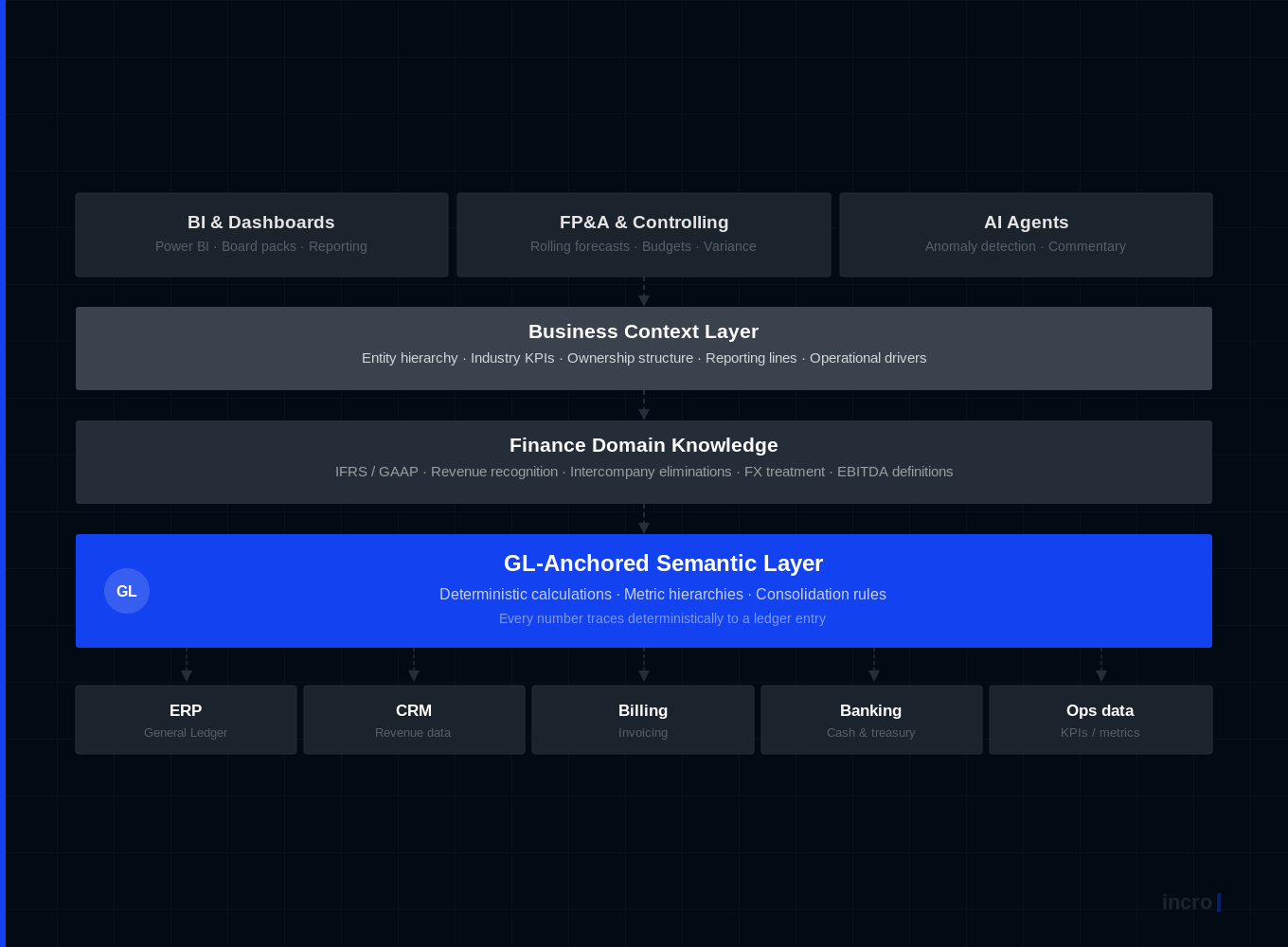
CFO Studio is a finance application built for finance teams of 5 to 50 people, on the Claude API. It isn’t a data platform. It starts where Fabric stops: with finance logic. It goes live in weeks, and for many companies it is the first step of a finance transformation rather than the end of one.
It has three layers, following our Finance Foundry model:
- Foundation. A dedicated reporting database fed from the ERP, budget spreadsheets and operational systems, or Microsoft Fabric as the source when the company already runs it. On top sit our own aggregation, business rules and consolidation models.
- Intelligence. Dashboards, chat over financial data and driver-based planning. You define the drivers, build scenarios on them, compare the scenarios side by side and turn the one you trust into the forecast. Plans sit next to actuals in the same model.
- Agents. Managed Agents: a library of ready-made finance agents, plus the ability for the finance team to build its own. Every agent in the team and the company is visible in one list. Agents can be chained, so the outcome of one becomes the input of the next. For example, a close-check agent flags unusual ledger entries and a variance agent picks up its findings to draft the commentary.
Finance logic that comes ready
The part that usually takes longest to build is already there. Consolidation models handle multiple entities, intercompany eliminations and currency conversion out of the box. Financial statements, variance analysis and KPI sets such as ARR, NRR and Rule of 40 come with templates for SaaS, fintech, e-commerce and PE portfolios. For reporting, chat and forecasting, the principle is: AI reasons, never computes. Every number comes from a deterministic engine, so the same question returns the same number and every number traces back to its source.
Modules for each finance team
CFO Studio is implemented as modules matched to how the finance function is organised: one for FP&A, one for the CFO office, one for the controlling team. Each module brings the data, logic, dashboards and agents that team works with. A company starts with the module where the pain is biggest and adds the others later, without rebuilding anything.
Your AI, your rules
CFO Studio exposes an MCP connector, so its data, finance logic and tools work inside the AI the company already uses, most often Claude, not only in Copilot or our own interface. This is the strongest part of the setup. You can build a reliable finance agent in Claude that works on CFO Studio’s data and tools, under the same definitions, permissions and rules as the rest of the team. Claude reasons and writes. CFO Studio supplies numbers that reconcile.
Access by role
Access is defined per role. Each department or position can work on its own dataset: a sales team gets dashboards and agents on sales data only, with no view of costs or salaries, while controlling sees the full ledger. The same rules apply in our interface, in Claude and to every agent. CFO Studio runs in the cloud or on-premise.
Time and cost: a platform project or a finance application
Fabric and CFO Studio cost money in different ways, and the bigger difference is time.
With Fabric, licences are the smaller part of the bill. The company pays for capacity, Copilot licences and Copilot Credits, and then funds a project: data engineering, certified semantic models, a planning model, agents. Without a data foundation in place, that is months of work, and a data team has to keep it running afterwards.
With CFO Studio, the company pays a subscription and a fixed-scope implementation. Sources are connected, the chosen module is configured on ready-made finance logic, and the team works in it within weeks, supported by incro rather than an internal data team.
That is why CFO Studio often comes first in a finance transformation. Finance gets reliable reporting, consolidation and planning now. When the company later builds on Fabric, CFO Studio takes Fabric as its source, and nothing built so far is lost.
Criterion by criterion
The table doesn’t keep score. Each row says in which situation which approach makes sense.
When to choose Fabric
Fabric is a good choice when finance is one of many consumers of data, and the company has people to build and run the platform. Typical signals:
- The company already runs Fabric or Power BI Premium, with mature, certified semantic models.
- There is a data team: a data engineer, a BI analyst, someone owning governance.
- Finance questions mix with sales, operations and HR data in one place.
- Planning is a company-wide process with many contributors, and the data team is ready to own the planning model in Fabric.
- People live in Microsoft 365, and an answer in Teams or Excel matters more than a separate tool.
- Security requirements demand one platform with labels, DLP and Purview controls.
In such a company, building parallel data infrastructure for finance would be a mistake. The real question then isn’t “Fabric or CFO Studio”, but “who builds the finance logic on Fabric”.
When to choose CFO Studio
CFO Studio makes sense when the problem is finance logic, not data infrastructure. Typical signals:
- The finance team has 5 to 50 people, works from the ERP and spreadsheets, and has no warehouse or data team behind it.
- The CFO needs reporting, consolidation, forecast and budget in weeks, as the first step of a transformation, with Fabric as an option later.
- The group has several entities and needs consolidation with eliminations and FX, not just roll-ups.
- You want to replace a standalone planning tool or a web of Excel models, and keep plans next to actuals, with driver-based scenarios the finance team runs itself.
- Numbers go to the board, investors or auditors and must be traceable to source.
- The team works in Claude or another LLM and wants reliable finance agents there, on its own numbers and rules.
- Different teams need different data: sales sees sales, controlling sees everything.
- Data must stay on your own infrastructure, or external controllers need access.
- The company doesn't run on the Microsoft stack, or doesn't want finance tied to a single vendor.
This is a common profile for PE portfolio companies and fast-growing mid-market businesses. They have an ambitious CFO, a finance team of 5 to 50 people and nobody to build a semantic model. Planning in Fabric doesn’t change that: it plans on top of a semantic model, so a company without one has nothing to plan on yet.
Often the best answer: both
In a company that already runs Fabric, CFO Studio doesn’t build a separate data foundation. Fabric becomes its source: dashboards, chat, scenarios and Managed Agents run on the data already in OneLake and semantic models, and CFO Studio adds what Fabric lacks, meaning ready-made finance logic and agents.
The division of roles is simple. Fabric holds and governs the data, and Copilot answers questions about it where people already work. CFO Studio computes what has to reconcile to the cent, builds the scenarios and runs the finance agents. Both sides speak MCP, so agents in one layer can use data from the other.
One rule follows: give the budget one home. If the company plans in Planning in Fabric, CFO Studio reads the plan from Fabric for variance analysis, commentary and agents instead of keeping a second copy. If finance owns the plan, it lives in CFO Studio’s driver-based scenarios. Either way, there is one version of the budget.
The one question that decides it
Before choosing a tool, answer this: who in your company will build and maintain the finance logic?
If you have a data team that understands finance, Fabric gives them excellent tools, now including planning. If that person doesn’t exist, CFO Studio delivers the logic ready-made in weeks, as a first step, and moves onto Fabric when the company does.
As of 6 October 2026. Fabric changes every month and some of the features described here are in preview. Check the current status before deciding.
Sources
- FabCon Europe 2026: The Fabric Announcements That Matter, Solv Systems, 29 Sep 2026
- What Microsoft’s September 2026 Copilot Update Means for IT Leaders, eGroup, 29 Sep 2026
- What is planning in Fabric?, Microsoft Learn
- Bring Enterprise planning to the AI Era with Planning in Microsoft Fabric IQ, Microsoft Fabric blog
- Planning in Microsoft Fabric: From insight to action, Microsoft Fabric blog, Sep 2026
- Known limitations in planning and Billing and usage for planning in Fabric, Microsoft Learn
- Translytical task flow overview, Microsoft Learn
Matt co-founded incro in 2020. Since then, he has worked with over 100 companies - from early-stage startups to PE-backed businesses across a wide range of industries.
He is an expert in corporate finance, FP&A set-up, and forecasting, and has built a reputation for turning complex financial functions into clear, board&investor-ready systems.
At incro, Matt drives company growth while designing the analytical frameworks and solutions that define how the firm delivers transformation — including co-creating CFO Studio, incro's AI-powered financial analysis platform.
He holds a degree from SGH Warsaw School of Economics and is the author of Methods and Procedures in the Assessment of Capital Investments (Difin, 2023), a rigorous framework for evaluating investment profitability, now used as an academic reference. Matt was named to the Forbes 30 Under 30 Poland list in 2025.
Your financial data won't fix itself.
30 minutes. We'll tell you exactly where your data is costing you money — and what AI can do about it.