Financial AI Agent Implementation
We design and implement AI agents for your finance function — built on deterministic financial models and clean data architecture, so outputs are accurate, auditable, and trusted by the people who act on them.
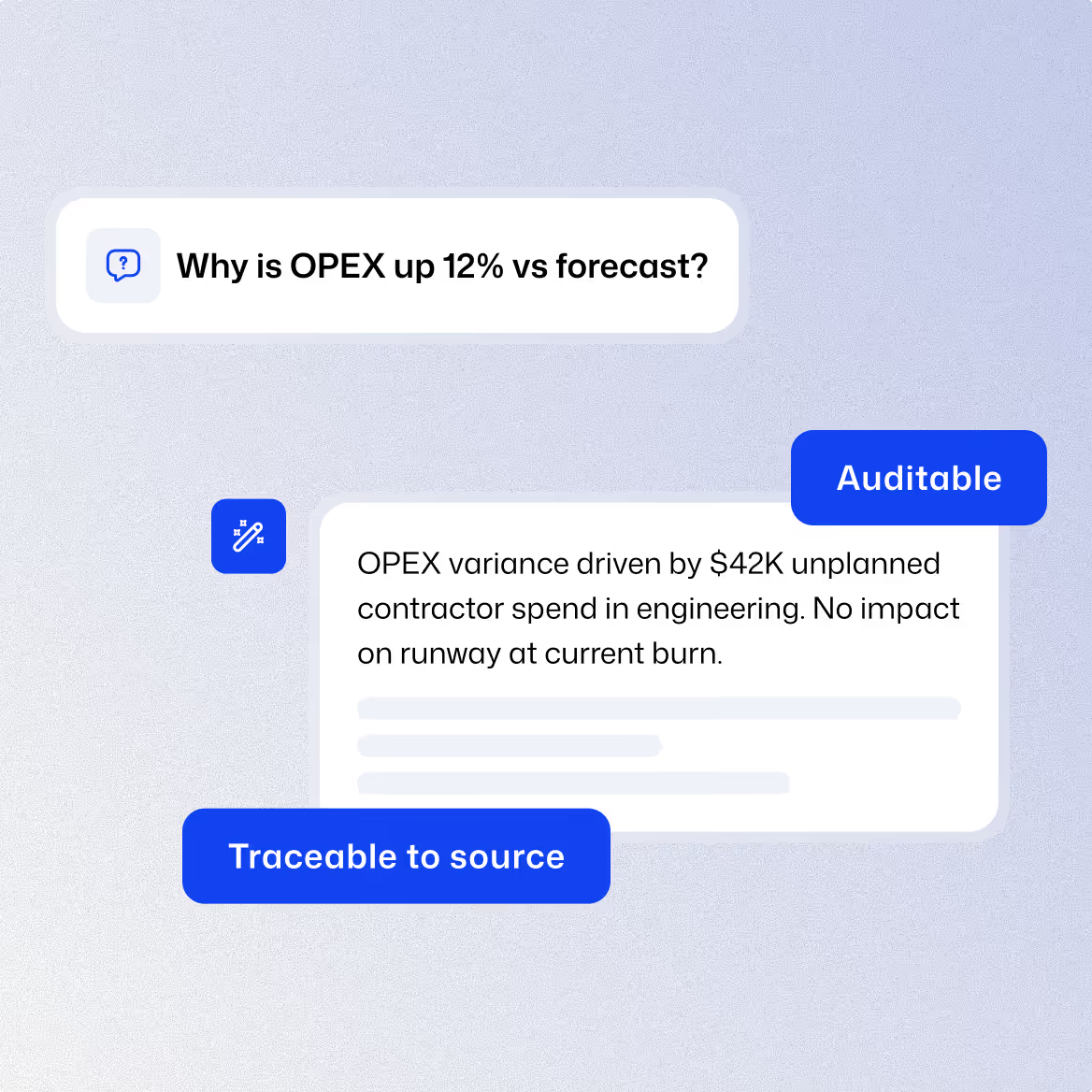
AI in finance fails when it's treated as a general-purpose tool. Financial outputs require precision that general-purpose AI wasn't designed to guarantee.
AI outputs that can't be signed off on
Generic AI tools applied to financial processes produce outputs that are difficult to verify and impossible to audit. In finance, an answer that can't be traced to source isn't an answer — it's a liability. It doesn't get adopted, and it shouldn't.
Point solutions that don't integrate
AI tools have been evaluated or piloted in isolation — a forecasting tool here, an anomaly detection tool there. Without an integrated architecture, each tool adds complexity rather than reducing it. The finance team ends up managing tools instead of using them.
High-value finance processes still running manually
Variance analysis, financial commentary, consolidation checks, forecasting updates — processes that consume significant finance capacity and follow deterministic logic every cycle. The case for automation is clear. The implementation approach that makes it reliable hasn't been in place.
Implementation that outran the data foundation
AI was deployed before the data architecture was ready. Outputs are inconsistent because the underlying data is. The technology worked. The foundation it was built on didn't — and the investment is sitting underperforming as a result.
What changes when we're done
From use case assessment to production AI agents.
Readiness Assessment & Use Case Design
Data architecture and process readiness assessed against AI implementation requirements. High-value, high-readiness use cases identified and scoped. Agent architecture designed before any build begins.
Agent Development & Testing
Agents developed against defined use cases. Extensive testing against real financial data — accuracy, consistency, edge cases, and failure modes. Finance team involved in validation throughout.
Deployment & Governance
Agents deployed to production environment. Governance framework established. Finance team trained on operation, monitoring, and escalation. Performance monitored against defined accuracy thresholds.
This service fits if
High-value finance processes are still fully manual
Variance analysis, financial commentary, forecast updates — processes that follow deterministic logic and consume significant finance capacity every cycle. The case for automation is clear. Reliable implementation is what's been missing.
AI pilots haven't progressed to production
Proof of concept work has been done — but outputs weren't reliable enough, the data foundation wasn't ready, or governance requirements weren't met. The pilot needs to become a production deployment with the right architecture behind it.
Your data architecture is sound
Clean, well-structured financial data — built by incro or your own team. AI implementation requires that foundation. Where it's in place, the value of deployment is immediate and significant.
Auditability is non-negotiable
Your finance function operates in a regulated environment, or under the governance expectations of institutional investors, PE ownership, or a listed structure. AI outputs need to be fully traceable — and designed that way from the start, not retrofitted.
AI agents in finance deliver when they're built on clean data, designed around deterministic financial logic, and governed for auditability. That combination — which is how we build — is what separates deployments that get adopted from those that don't.


AI in finance should make your team more precise — not leave them less certain about the numbers.
30 minutes. We'll assess your data readiness and tell you which AI use cases are deployable in your environment right now.
What CFOs ask before they engage
How is your approach to AI in finance different from a standard AI implementation?
We build on deterministic financial models rather than relying solely on large language model outputs for financial calculations. AI handles interpretation, commentary, and pattern recognition — the parts it's suited for. Financial logic is handled by structured models with defined calculation rules. That combination produces outputs that are accurate, consistent, and auditable — which is the standard finance requires.
What data infrastructure is required before AI implementation?
A clean, well-structured financial data model with consistent definitions across source systems. Where that doesn't exist, we scope the data architecture work that needs to precede AI deployment. Implementing AI on top of fragmented or inconsistent data produces fragmented and inconsistent outputs.
How do you handle regulatory and audit requirements for AI outputs?
Governance and auditability are designed into the architecture from the outset — not added after deployment. Every AI output is traceable to source data and calculation logic, with defined escalation paths for exceptions and human review requirements for material outputs.
What does ongoing operation look like after deployment?
Agents run on your infrastructure and are owned by your finance and technology teams after handover. We provide operational documentation, monitoring frameworks, and a defined support model. Most clients retain incro for periodic review and enhancement cycles as use cases evolve.